crossary
How it worksSee it workTrustPricingFree template
Log inStart free
Start free
Source → target field mapping, reviewed

A wrong mapping is worse than an honest gap.

Crossary turns messy source and target specs into a reviewed, implementation-ready mapping workbook — every derived rule backed by its exact source quote, every uncertain one flagged for you. It maps the spec, not the data. Nothing moves until you sign off.

Start free — map your first integrationSee a reviewed row

3 integration credits free · no card · your mappings never train a shared model.

Not ready to upload anything? Walk a worked sample first — free, no files needed.

AI proposes · you decide
hubspot → salesforce
the sample10 mapped · 1 honest gap · 11 target fields
source fieldhigh confidence
Company Namedirect
→ AccountName
“ AccountName — the company. In HubSpot this is "Company Name".
source fieldno confidence
no clear sourceunknown
→ Region
?Region (sales territory) isn't in the HubSpot export. Your kickoff notes already decided this — left unmapped here, assigned in Salesforce. Flagging, not guessing it from Country.
crossary

Source-to-target data mapping that shows its work — and flags the gaps instead of guessing.

Product
The reviewed rowHow it worksThe guided sampleWorked examplesGuidesFree mapping templatePricing
Trust
Trust mechanicsFAQSecurityPrivacy & data
Company
reads
xlsx
pdf
csv
json
xml
xsd
sql
yaml
Who it's for

If you hand-build the mapping sheet someone else implements — this is for you.

01
Integration & interface engineers
Mapping heterogeneous source specs — PDF, XML, EDI-style guides, Excel (.xlsx) — to a target schema.
02
Implementation & onboarding consultants
Turning a client's messy spec into a reviewed mapping workbook on day one — not week three.
03
Data & migration engineers
Building the field inventory and the data mapping document for ERP, CRM, and legacy migrations — before any records move.
04
EDI & interface analysts
Turning implementation-guide PDFs into evidence-backed mapping rows where the “why” has to be defensible later.
How it works

A strict five-stage pipeline.
Then a round-trip.

Upload to a signed source-to-target mapping workbook in five steps — and back again, without losing a note.

01
Artifacts

Drop in your source + target specs. If a file can't be fully read, it tells you exactly how much it dropped.

xlsx · pdf · csv · json · xml · xsd · sql · yaml

02
Fields

A field inventory is extracted from both sides — every path, every column — so you map against the real surface.

03
Mapping

For each target: a proposed source, type, reasoning, and confidence — plus the verbatim spec line behind any derived rule. Abstains when unsure.

04
Validation

A deterministic check for structural & cardinality blockers. Zero AI, zero spend.

05
Export

A signed .xlsx your team can open anywhere — that reconciles cleanly when it comes back.

the round-trip

Export is a signed workbook, not a locked app view.

Hand it to a developer or a client. Edit it in Excel, Google Sheets, or Numbers — change decisions, add notes — then re-import. Crossary applies what matched, skips rows that moved underneath you instead of overwriting them, and turns every note into a tracked question.

  1. Export
    A signed .xlsx — every row stamped with a stable id.
  2. Edit anywhere
    In Excel, Google Sheets, or Numbers — no Crossary login required.
  3. Re-import
    Applies what matched, skips what moved, never loses a note.
Anatomy of a reviewed row

Six things every row tells you.
Nothing taken on faith.

Open any proposed mapping and you see exactly why the AI suggested it — and how sure it says it is. The evidence, not the confidence, is the product.

source field ①
S_SHIP_DATE
→
target field ②
order_date *
confidence ③
high
mapping type ④
transformation
to_date(S_SHIP_DATE)
evidence — verbatim from the source ⑤
“ S_SHIP_DATE — ship date, ISO-8601 string. Target order_date is a date type. ”
source spec · sheet 1 · row 14
reasoning & assumptions ⑥

Names and semantics align; the only change is a string→date cast. Assumes the source string is well-formed ISO-8601 — flagged for your review.

read it like a reviewer
①
The proposed source
The real field it pulls from — or blank, if nothing fits.
②
The target field
What you're mapping to. An amber * means required.
③
Confidence
The AI's own certainty — high, medium, low, or none. A triage cue, not a guarantee; weigh it against the evidence.
④
Mapping type
Direct, transformation, constant, lookup, conditional, generated — or unknown.
⑤
Verbatim evidence
The exact source quote it's based on, with its location.
⑥
Reasoning & assumptions
Why — and every assumption it made, surfaced for you to challenge.
See it actually happen

The honest gap it won't guess —
and the round-trip that holds.

The real sample, end to end: where the AI withdraws a tempting guess and asks instead, and where your edits survive a trip through Excel and back.

the sample
hubspot → salesforce
source fieldlow confidenceno confidence
Countryno clear source
→Region
No HubSpot field tracks sales territory, and it must not be guessed from Country. The kickoff notes mark this as an accepted, pre-decided gap — so it's flagged, not asked.
?Region (sales territory) isn't in the HubSpot export. Your kickoff notes already decided this — left unmapped here, assigned in Salesforce. Flagging, not guessing it from Country.

When it isn't sure, it says so.

confidence: none · no guess

That workbook layout is yours either way — take the source-to-target mapping template as a sample-filled .xlsx. No email, no account.

In the app

Everything above, actually running.

The real interface, on the guided sample you can run for free — no files, no card, no credits spent.

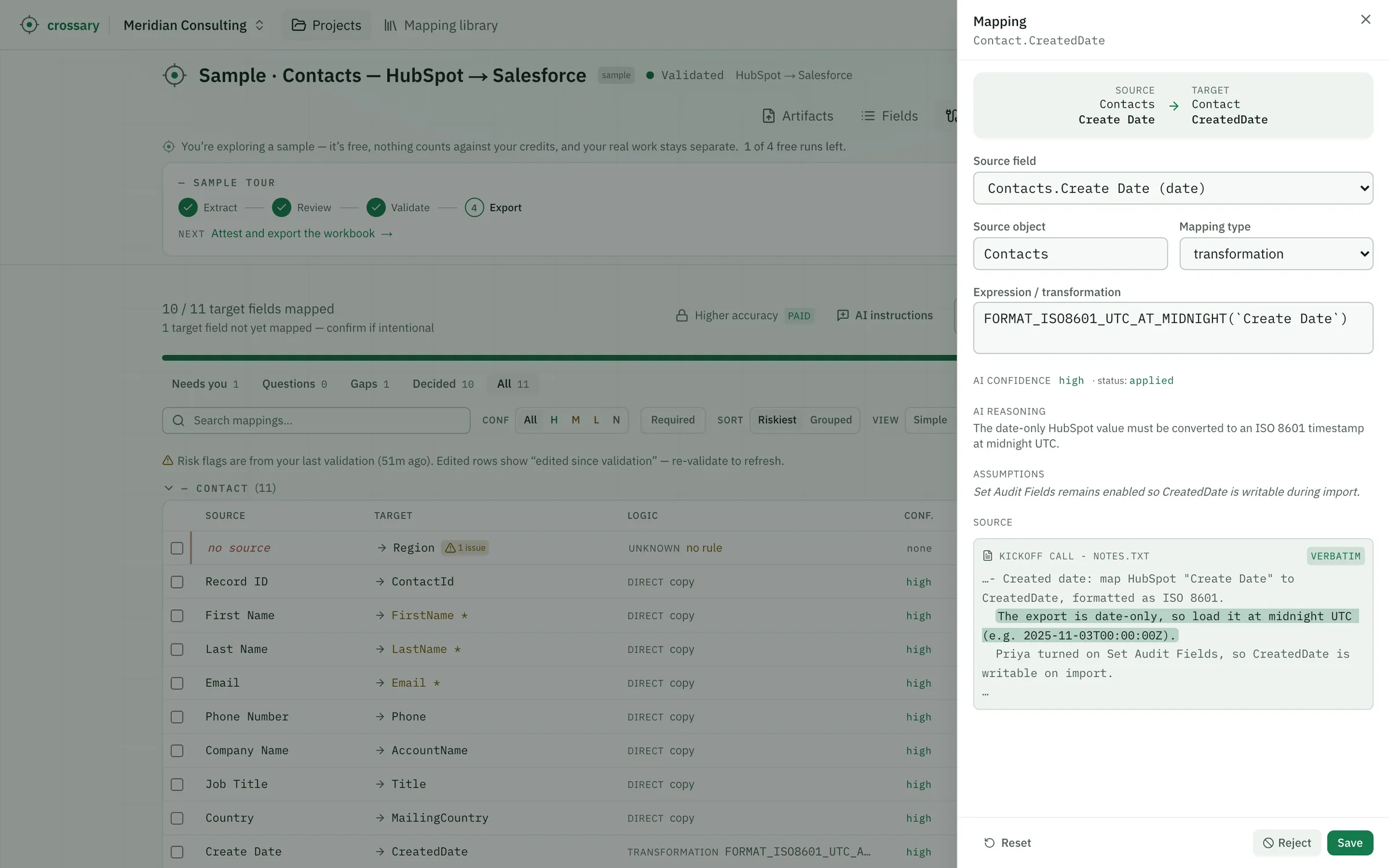
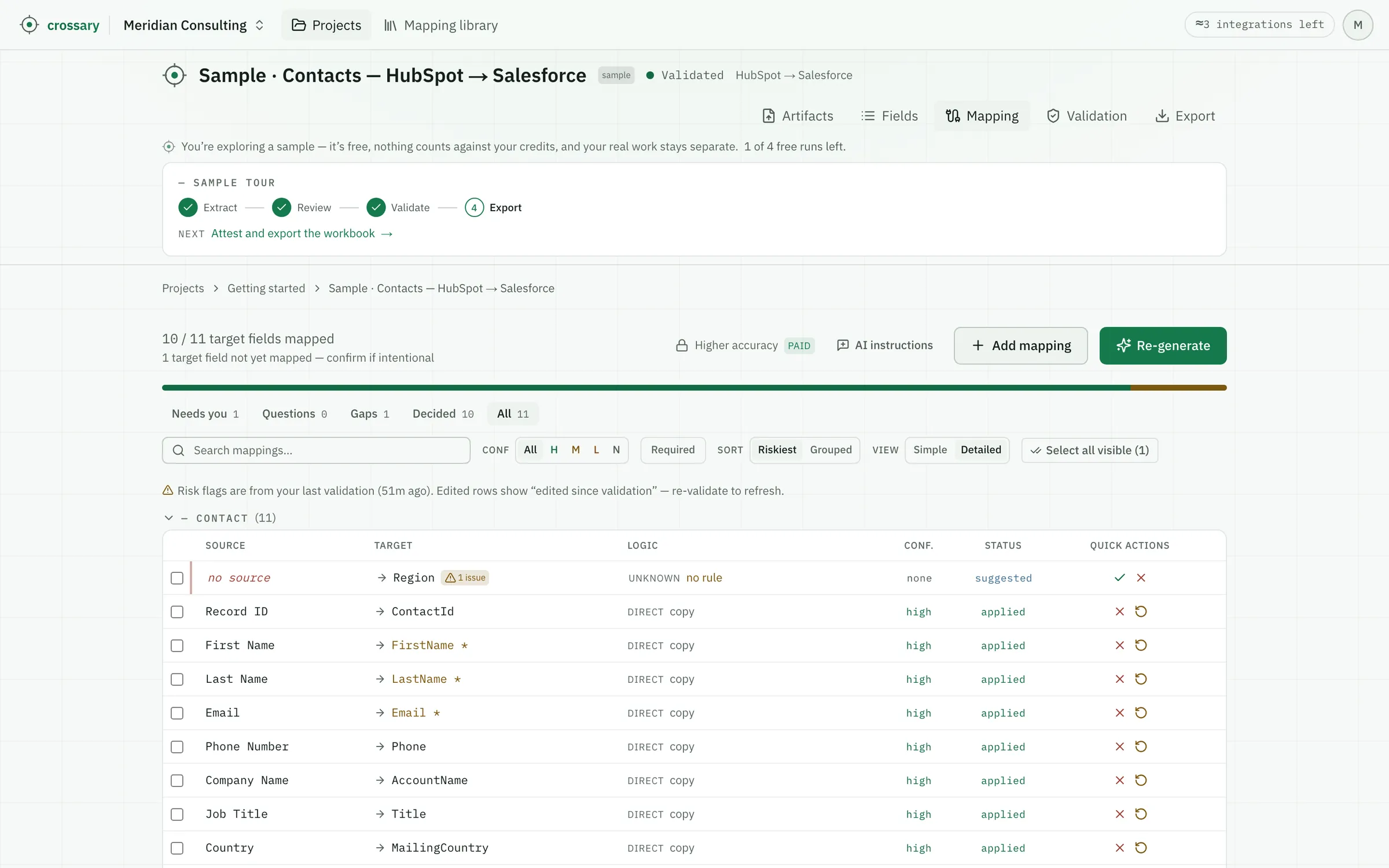
Crossary's mapping review table for a HubSpot to Salesforce contact sync: eleven source-to-target rows with mapping type, confidence and status. Sorted riskiest-first, so the top row is the target field Region with no source and one issue flagged.
Every row, and the one it wouldn't guess.Ten of eleven target fields mapped, one left as an honest gap — sorted riskiest-first, so the row that needs you is the row you land on. This is the sample anyone can run.

Want more than screenshots? Complete runs over public vendor specs are published unedited — every proposal, every gap, every question — as worked examples.

Mapping memory

A gap you filled once stops being a gap.

Sign off an export and your approved mappings become a private, workspace-scoped library. On the next run it gap-fills only the targets the AI abstained on — inserted as suggestions you still review, never auto-applied.

  • Scoped to your workspace — it never crosses to another.
  • Captures the decision only — no evidence, reasoning, or sample values.
  • Logic you wrote stays inside the project you wrote it in.
  • It never trains a shared model.
next run · a gap, pre-filled
industry_vertical
library
→ Industrysuggested

Reused from a pair you approved before — it fills a gap the AI would otherwise abstain on, and still waits for your sign-off.

Trust & data

Trust isn't asked for here — it's enforced in code, and written down.

Guaranteed in code
Honest about what it read

If more than ~10% of a source is dropped during ingestion, it stays flagged — in the app and on the export cover sheet. A partial read is never reported as complete.

“Validated” means one thing

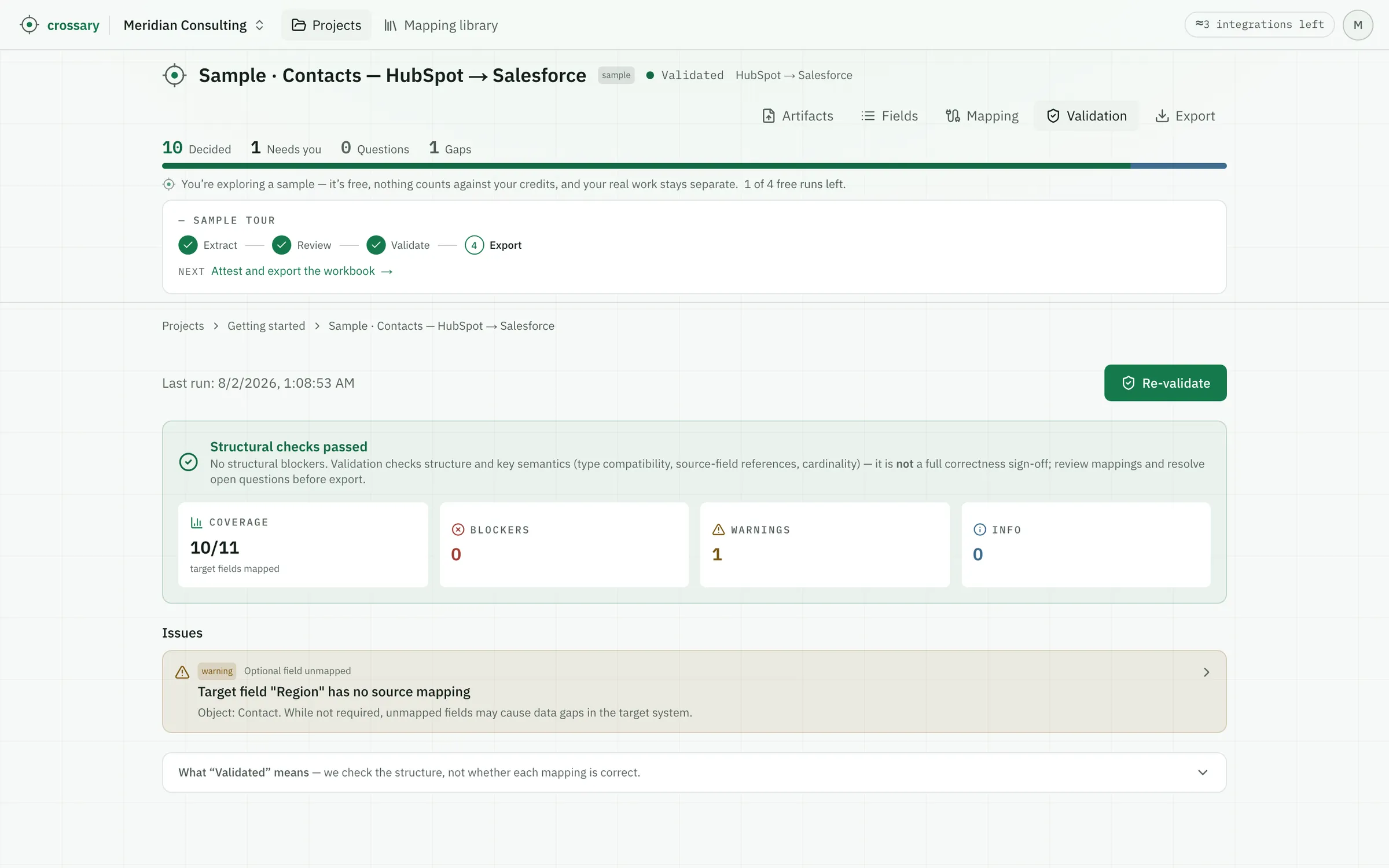
Deterministic, zero AI spend. Validation checks structure and key semantics (type compatibility, source-field references, cardinality) — it is not a full correctness sign-off. The app spells out both lists — what it checked, and what it didn't — on the validation screen itself.

Never loses your note

On re-import it applies what matched, skips what changed underneath you, and turns every reviewer note into a tracked question. Nothing is silently overwritten.

Schema-validated, or rejected

Every AI response is checked against a strict schema before it can touch your data. A malformed result is thrown away, never persisted.

Your data
Specs in, not your records

Crossary maps from your source and target specs — schemas, dictionaries, guides. It's built to work from the spec, not your data, so there's no need to upload production records or PII. If you choose to attach a real export to check the spec against it, that's off by default, and the file is read for its shape and discarded — never stored, never sent to the AI.

Yours to export or delete

Export everything, or delete it per record — any time, self-serve. GDPR portability and erasure are built in, not a support ticket.

Sent only to run the AI

Specs go to our AI provider (OpenAI, US) only to run your job. They may be held there up to ~30 days for abuse monitoring, then deleted — and never used to train a shared model. Deleting an integration here doesn't reach a copy already processed there.

Subprocessors in the open

Every third party that touches your data is listed with its purpose and location, and we give notice before that list changes. Nothing about where your data goes is a secret.

Privacy & data terms →Subprocessor list →Security →

Pricing

Start free. Pay for AI runs, never for reviewing.

Reviewing, validating, exporting, and round-trip re-import don't call the AI — so they're always free, on every plan.

Free
$0

For your first real integration.

Start free
  • 3 integration credits, one-time
  • Free review, validate & export
  • Round-trip re-import
  • Mapping Memory included
  • 1 workspace · up to 2 members
Most teams start here
Pro
$99/ month

~20 integrations a month.

Start with Pro
  • Everything in Free
  • ~20 integration credits / mo
  • Heavier reasoning pass (more compute per run)
  • Unused credits roll over
  • 3 workspaces · up to 3 members
Team
$399/ month

~75 integrations a month.

Start with Team
  • Everything in Pro
  • ~75 integration credits / mo
  • Unlimited workspaces · up to 10 members

Plus applicable taxes.

Run out? Existing work is never blocked — review, validate, export & re-import stay free. Unused credits roll over, you can buy more anytime, or upgrade. Only new AI runs pause.

Bigger team, procurement review, or a counter-signed DPA? Talk to us.

Questions, answered straight

The honest answers, before you sign up.

What's a credit?

Roughly one standard integration. Higher Accuracy and unusually large or heavily re-run jobs use more — and you can see what each integration cost.

What's always free?

Reviewing, validating, exporting, and round-trip re-import. They don't call the AI, so they never use a credit.

What if the first pass isn't right?

Editing rows by hand, re-validating, re-exporting, and round-trip re-import are always free. Asking the AI to have another go isn't: re-running extraction or mapping costs roughly what the first run did, and submitting answers to a flagged question re-runs that phase too, so it's charged the same way. Credits are metered on actual usage rather than per click, and you can see what each integration cost.

What does a “signed” workbook mean?

That a person attested to it. Before an export you confirm you reviewed the mappings, and that attestation — who, when, and what validation had passed — is stamped on the workbook's cover sheet. It's a record of human review, not a cryptographic signature, and the file opens normally in Excel, Google Sheets, or Numbers.

Is accuracy gated to higher plans?

Every plan gets the same core mapping quality. Higher Accuracy — an optional, heavier pass — is on paid plans; Mapping Memory is included on every plan.

What happens when I run out?

Existing work is never blocked — review, validate, export and re-import stay free. Unused credits roll over, you can buy more anytime, or upgrade. Only new AI runs pause.

How do I upgrade?

Click subscribe on the plan you want — secure checkout, and your plan activates immediately.

Does my data train your model?

No. Mapping Memory is scoped to your workspace and never crosses it; no shared model learns from your mappings.

Map your first integration
in the next ten minutes.

Upload a source and a target spec. Get back a reviewed, evidence-backed mapping workbook — with every honest gap flagged for you.

Start free

3 integration credits free · no card · no lock-in.

SupportTermsLog in
© 2026 Crossary. All rights reserved.AI proposes · you decide · nothing ships you didn't approve.
TermsPrivacyCookiesSubprocessorsDPA